
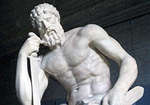
Ajax
Ajax was a hero in Greek mythology, son of King Telamon of Salamis and Periboea. He played a pivotal role in the myth of the Trojan War. He is also known as Telamonian Ajax, Greater Ajax, or Ajax the Great, to be distinguished from Ajax the Lesser, son of Oileus.
Who Was Ajax in Greek Mythology?
Ajax was the second greatest warrior in the Greek army at Troy, ranked below only his cousin Achilles. He was the son of King Telamon of Salamis, famous for his enormous tower shield and his role as the defender of the Greek camp, and he ended his own life after losing the contest for the armour of Achilles.
- Parents: Telamon, king of Salamis, and Periboea; half-brother of the archer Teucer
- Lineage: grandson of Aeacus and great-grandson of Zeus, which makes him Achilles’ first cousin
- At Troy: commanded twelve ships from Salamis and fought as the army’s defensive anchor
- Death: suicide by his own sword, after Achilles’ armour was awarded to Odysseus instead
Why Is He Called Ajax the Great?
He is called Ajax the Great, or Telamonian Ajax, to separate him from a second Greek commander of the same name who fought in the same war – Ajax the Lesser, son of Oileus. Ancient authors needed the distinction because both men appear side by side in the Iliad.
- His Greek name is Aias (Αἴας); Ajax is the Latin form that reached English
- Ajax the Great came from Salamis and was famous for his size, his shield, and his steadiness
- Ajax the Lesser came from Locris, was small and fast, and is remembered mainly for dragging Cassandra from Athena’s temple during the sack of Troy
- The two are sometimes called the Aiantes and fought together as a pair in several battles
Ajax in the Trojan War
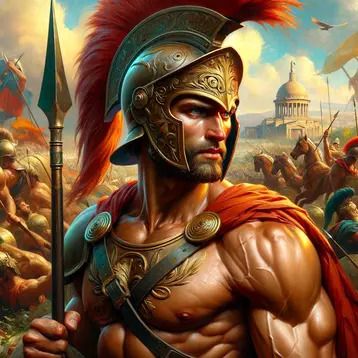
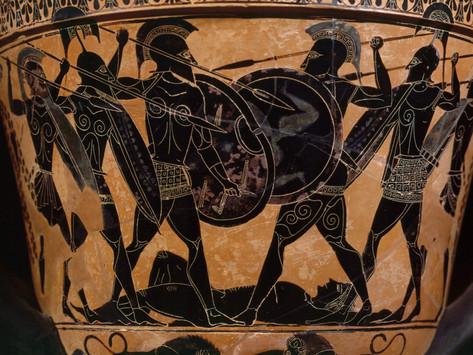
Ajax was the wall the Greek army stood behind. Where Achilles and Diomedes are attackers, Ajax is almost always defending – the camp, the ships, a retreat, or the body of a fallen comrade.
- He fought Hector to a draw in single combat, held the ships when the Trojans broke through, and carried Achilles’ body out of the fighting while Odysseus held off the Trojans
- Homer calls him the “bulwark of the Achaeans,” and he alone among the great heroes is never given an aristeia – a set-piece of offensive glory
- He is never wounded anywhere in the Iliad, and he is effectively the only major figure on either side who wins his battles without a god fighting at his shoulder
- He often fought paired with his half-brother Teucer, who shot arrows from behind the cover of his shield
Ajax Portrayal
He was described as being particularly tall, extremely strong and fearless. His teacher was the Centaur Chiron, and he was taught side by side with the great hero Achilles.
The Shield of Ajax
His shield was his emblem: a tower of seven layers of oxhide faced with an eighth layer of bronze, made by the leatherworker Tychius and tall enough to cover his whole body. It is the opposite of Achilles’ shield in every way that matters.
- Achilles’ shield was forged by the god Hephaestus; Ajax’s was made by a mortal craftsman with no divine decoration at all
- Teucer sheltered behind it between shots, making the pair a single fighting unit
- His son was named Eurysaces, meaning “broad shield,” after it
Ajax and Hector
During the Trojan War, Ajax was chosen to duel Hector, prince of Troy, a duel which lasted a whole day. Towards the end of the day, Zeus sent heralds to declare the duel a draw. The duelists exchanged gifts, showing the respect towards their opponent; Ajax gave a purple sash to Hector and received a sword. The two heroes duelled a second time later in the war, when the Trojans had almost reached the Greek ships. Ajax hurled a huge stone against Hector, almost killing him. More duels followed between the two, and in one duel, Ajax was defeated and was forced to flee. Hector managed to set one of the Greek ships on fire.
Ajax and Achilles
In the battles described above, Achilles was absent as a result of a dispute between him and Agamemnon, leader of the Achaeans. Ajax substituted Achilles in the battle, and he was also asked to speak to Achilles in order to change his mind. The great hero returned to fight again, only after the death of his best friend, Patroclus.
Ajax's Death
At the end of the Trojan War and after Achilles' death, Ajax along with Odysseus fought against the Trojans to retrieve the body of the hero. After burying him, the two wanted to claim Achilles' armour for themselves. During the competition, Ajax said that he should receive it for all of the great deeds that he performed during the war; Odysseus, better skilled at speaking, managed to convince the Greeks and was offered the armour. Ajax, angry at what had happened, deliberately fell on his own sword and died.
The Madness of Ajax
Between the lost contest and the suicide comes the episode that made Ajax a tragic figure. Humiliated by the verdict, he set out at night to murder Agamemnon, Menelaus, and Odysseus – but Athena struck him with madness, and he slaughtered the army’s captured livestock instead, torturing a ram in the belief that it was Odysseus.
- When his sanity returned at dawn and he saw what he had done, the shame was worse than the original injustice
- The sword he fell on was the one Hector had given him after their duel – the gift of his greatest enemy became the instrument of his death
- Because he died by suicide, he was buried rather than cremated, and a quarrel broke out over whether he deserved a funeral at all; Odysseus argued in his favour
- The story is told in full in Sophocles’ tragedy Ajax, one of the earliest surviving portraits of a soldier destroyed by his own war record
The Silence of Ajax in the Underworld
Ajax has the most famous silence in Greek literature. When Odysseus meets the dead in the Odyssey, he tries to make peace with the shade of Ajax, who says nothing at all and walks away into the dark.
- Odysseus admits in that scene that he wishes he had never won the armour
- The refusal to speak is the strongest statement in the passage, and ancient critics singled it out for praise
- Back home, Telamon disowned Teucer for returning from Troy without his brother’s body or his armour, and exiled him to Cyprus
- Ajax was worshipped as a hero at Salamis with a festival, the Aianteia, and an Athenian tribe was named after him
See Also: Trojan War, Hector, Odysseus, The Madness of Ajax, Telamon, Achilles, Teucer, Ajax the Lesser, Chiron

 Cite This Article